Sleep & anxiety
Sleep and calm, without shortcuts
A proper assessment of what is actually keeping you awake or on edge — and the treatment that genuinely works for it, which for both insomnia and anxiety is not a tablet. This is the most restrictive service we run, on purpose.
Fully online. Video consultation with Dr Qurbain, medication dispensed to your door, and no need to travel anywhere.
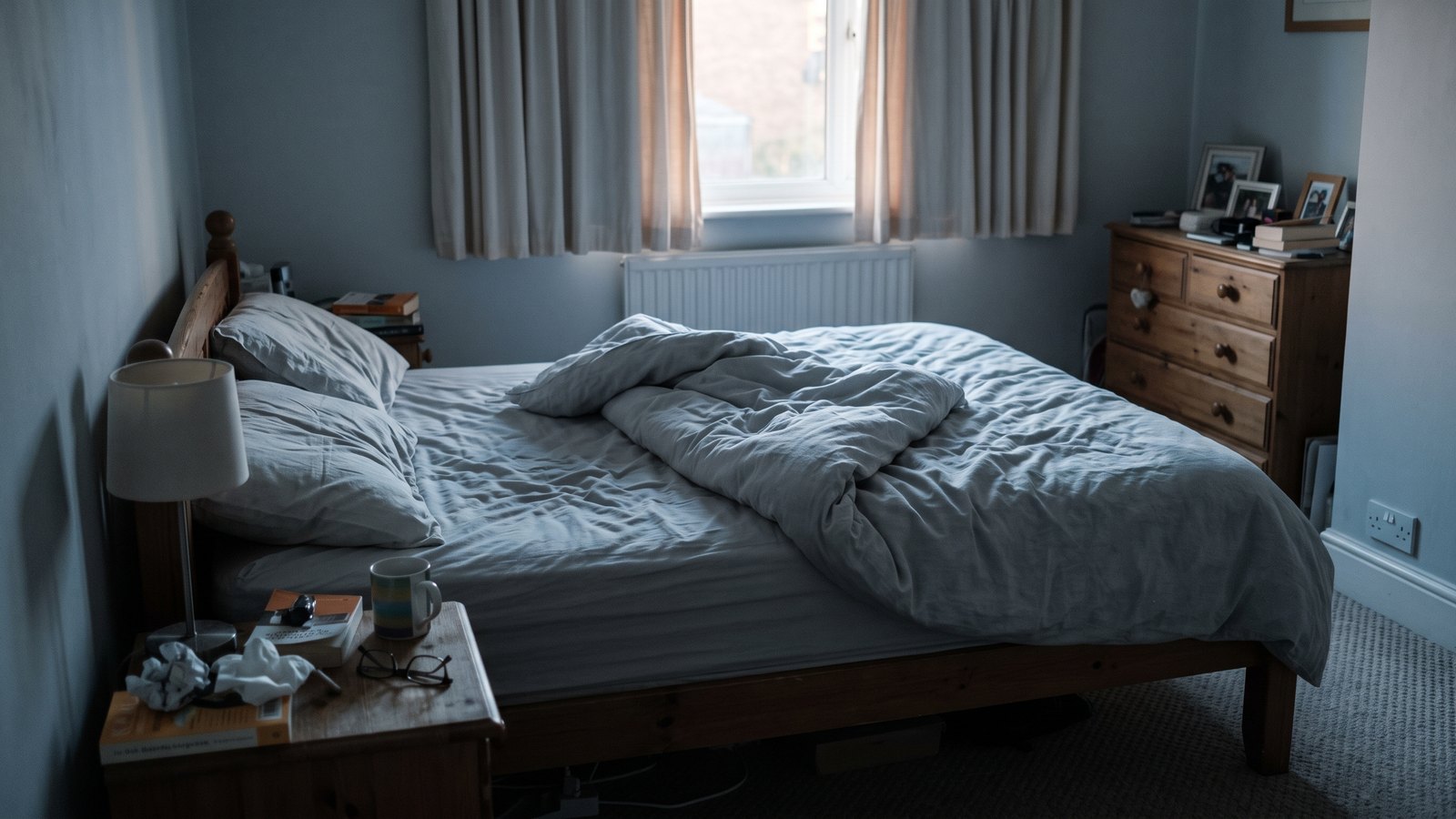
Lying awake, and dreading being handed a sleeping tablet?
If any of these sound familiar, this consultation was built for you.
You want the cause looked at, not just the symptom sedated.
You want treatment that still works in a year.
You have been told to practise sleep hygiene and found it insulting.
You want to be taken seriously without being medicated.
If you came here for sleeping tablets, read this part first.
This service will never prescribe benzodiazepines, Z-drugs, controlled drugs of any kind, sedating antihistamines or sedating antidepressants used as sleeping tablets, gabapentinoids, or pregabalin for anxiety. Not at a low dose, not briefly, however long-standing your use and however the request is framed. If that is what you are looking for, you will be told plainly and referred to your GP.
The reason is not squeamishness. This patient group includes people at risk of suicide, people with undiagnosed bipolar disorder, and people with undiagnosed sleep apnoea — for whom sedation is actively dangerous. A remote service that prescribes sedatives casually causes serious harm, and the restriction is how this one avoids that.

How it works
Four steps, all from home
Risk assessment, every single time
Direct questions about low mood, hopelessness, and thoughts of self-harm or suicide — plans, means, protective factors, previous attempts. Asked at every contact and recorded in your own words. Never skipped, and never guessed at from how you seem.
Measured and investigated
Validated anxiety and mood scores at baseline and every review, and a severity measure for insomnia. A sleep diary over about two weeks. Screening for sleep apnoea. Blood tests — full blood count, ferritin, thyroid, HbA1c, kidney and liver function — to rule out physical causes before any psychotropic is considered.
Non-drug treatment, offered first
For insomnia, CBT for insomnia is the first-line treatment and you are referred for it digitally. For anxiety, low-intensity psychological intervention and NHS Talking Therapies — which you can self-refer to without a GP, and we give you the link. No medication is considered until that has been offered and either tried or declined.
Medication only within strict limits
If a prescription is appropriate at all, it comes with limited quantities, a defined review, and for an SSRI, the requirement that your GP knows and agrees to be involved. Reviews repeat the full risk assessment each time.
What is never prescribed here
This is the most restrictive service we run, deliberately. This patient group includes people at risk of suicide, people with undiagnosed bipolar disorder and people with undiagnosed sleep apnoea, for whom sedation is actively dangerous.
What this service provides
Assessment and referral
- Structured assessment of insomnia and anxiety, including physical and psychiatric causes
- Sleep apnoea screening — a positive screen means referral, not sedation
- Referral to digital CBT for insomnia, which is the actual first-line treatment
- NHS Talking Therapies, which you can self-refer to
- Sleep hygiene and lifestyle advice in writing — necessary, and not sufficient on its own
Limited prescribing
- A melatonin preparation, short-term, for primary insomnia in adults aged 55 and over within its licence; outside that age it is off-label and discussed and consented as such
- Initial supply capped at four weeks as Metovia policy — the licence allows longer, and we are telling you that rather than implying it is a legal limit
- A beta-blocker for predictable situational physical symptoms — tremor, palpitations, sweating — and not as a treatment for an anxiety disorder
- An SSRI, only where every one of the conditions below is met
The SSRI conditions, in full
- A diagnosis of generalised anxiety or panic disorder meeting national criteria, with both scores recorded
- Non-drug treatment already offered, and tried or declined
- No bipolar feature, no suicidal thoughts, no substance dependence
- Your GP notified and agreeing to be involved in monitoring — an SSRI is not started remotely for anyone whose GP will not know
- Review at one to two weeks, four weeks, twelve weeks, then at least every three months

What actually works for insomnia
CBT for insomnia outperforms medication, and unlike medication its benefit persists after you stop. National guidance places it ahead of drug treatment, which is why it is offered first here rather than as an afterthought. It takes a few weeks of effort and it is genuinely harder than taking a tablet — it is also the thing most likely to still be working in a year. Where a medicine is prescribed, it is an adjunct to that, never a replacement for it.
If you are in crisis right now
Side effects, and what to do about them
Read
If you are having thoughts of ending your life, please get help today rather than waiting for an appointment.
- Call 999 or go to A&E if you are at immediate risk.
- NHS 111, option 2 for urgent mental health help.
- Samaritans: 116 123, free, any time.
- If risk comes up during a consultation here, the doctor stays on the call — the consultation is not ended while you are at acute risk. A safety plan is made with you and sent in writing, crisis contacts are given during the call, your GP is contacted the same working day, and no prescription is issued at that consultation.
- Where symptoms are driven by circumstance — bereavement, debt, abuse, overwork — the right response is support and practical help, not medication, and we will say so.
What is never prescribed, and who we refer
Who this service cannot treat, and why
Read
The first list is absolute. The second means a different clinician is the right one.
- No benzodiazepines. No Z-drugs. No controlled drugs of any schedule. No gabapentinoids. No pregabalin for anxiety. No sedating antihistamines or sedating antidepressants as sleeping tablets. None of these, under any circumstances
- Current suicidal thoughts, intent, plan or recent self-harm — escalated, supported, not prescribed for
- Any history of bipolar disorder, mania or hypomania, or a family history raising it — starting an antidepressant risks precipitating mania. Referred
- Psychosis or any psychotic symptom
- PTSD, OCD or an eating disorder — these need specialist pathways
- Severe depression, or moderate depression affecting your functioning
- Current or recent alcohol or substance dependence, or benzodiazepine dependence or withdrawal
- Already under a mental health team, or on psychotropic medication started elsewhere — that clinician coordinates your care; we do not duplicate it
- Suspected sleep apnoea — referred, because sedation in untreated apnoea is dangerous
- Suspected narcolepsy, restless legs, or acting out dreams — referred to sleep medicine
- Shift-work or body-clock disorders needing specialist management
- Pregnancy or breastfeeding, and anyone under 18
- Anyone who has been sleeping with the help of a sedative from an unregulated source — that needs a GP-led plan, not a remote prescription
Chest pain, palpitations with blackouts, or breathlessness are not labelled as anxiety without cardiac assessment. Nor is sudden severe anxiety in an older adult, where a physical cause has to be excluded first.
Every review starts with the risk assessment
The full review and monitoring schedule
Read
Each review repeats the full risk assessment and rescores both measures, then looks at response, side effects, adherence, alcohol and substance use, and what is happening in your life. Non-response is treated as a diagnostic question, not a dose question — we refer rather than escalate indefinitely. If you miss a review, supply stops. Because of the risk profile of this group you are not simply discharged: we contact you and notify your GP. GP involvement is treated as essential to safe care here: anyone who declines GP notification is not prescribed for by this service.
Non-drug treatment comes first, and that is not a formality
CBT for insomnia outperforms medication, and unlike medication its benefit persists after you stop. National guidance places it ahead of drug treatment.
Has non-drug treatment been offered, and either tried or declined — with that recorded?
If not
No medication is offered yet. You are referred for digital CBT for insomnia, or to NHS Talking Therapies, which you can self-refer to without a GP. We give you the link.
If it has
Medication can be considered, within strict limits — limited quantities, a defined review, and for an SSRI, your GP knowing and agreeing to be involved.
Our approach follows current national guidance. See the guidelines we work to.
Initial consultation
Your initial consultation is paid when you book, before the consultation, and is charged whether or not treatment is prescribed. A follow-up review is paid when it happens, and only if you or your doctor decide you need one.
Joining the waiting list is free. Medicine, if prescribed, is bought separately from the dispensing pharmacy and its cost is confirmed with you before you pay for each supply.
Video consultation with the doctor, full risk assessment, validated scoring, sleep apnoea screening, baseline blood tests reviewed by the doctor, referral to non-drug treatment, and a written plan. Medication, where it is within the limits above and prescribed, is dispensed separately by a registered pharmacy and priced before you pay.