Hair loss
Keep the hair you have
Pattern hair loss is treatable, and the earlier you start the more there is to protect. A proper diagnosis first, then treatment that is right for you — entirely online, from wherever you are.
Fully online. Video consultation with Dr Qurbain, medication dispensed to your door, and no need to travel anywhere.
Noticed it in a photograph before you noticed it in the mirror?
If any of these sound familiar, this consultation was built for you.
You keep checking the same spot in different lights.
You want to know what is actually causing it before you treat anything.
You have read a lot online and trust almost none of it.
You would rather start early than wish you had.
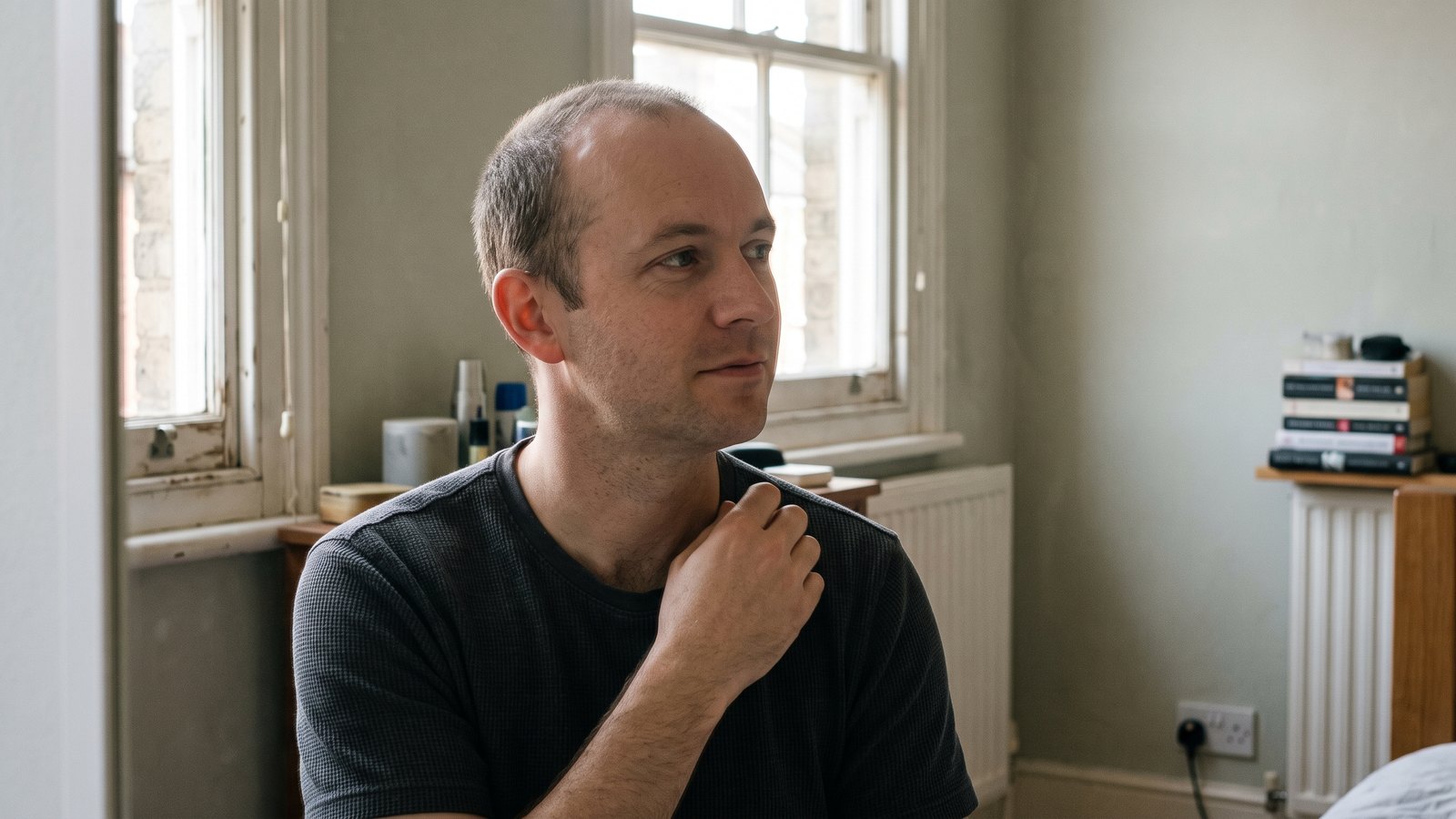
Treatment protects what is there. It cannot bring back what has gone.
That single fact is the most useful thing to know about hair loss. Medication slows or halts further loss, and in many people thickens what remains — but it works on follicles that are still alive. The hair you still have today is the hair worth acting on.
It is also why a diagnosis comes first. Pattern hair loss, thyroid problems, iron deficiency and stress-related shedding all look similar in the mirror and need completely different treatment. Prescribing before knowing which one you have is guesswork, and we would rather not guess.

How it works
Four steps, all from home
Photographs and history
You send standardised photographs — front, crown and both temples, in even light. We take a full history: when it started, how fast, whether it is diffuse or patterned, family history, recent illness, new medicines.
Video consultation
Dr Qurbain examines your scalp on video at magnification, looking for the signs that separate pattern loss from causes that need a dermatologist. Your pattern and stage are recorded so later photographs can be compared against them.
Blood tests
A home kit or a local phlebotomy appointment: full blood count, ferritin, thyroid function and vitamin D. Results are reviewed by the doctor before anything is prescribed, and anything abnormal is treated or referred first.
Your plan
Treatment where it is appropriate, dispensed to your door by a registered pharmacy. A written summary of everything discussed, and your GP is told what you have been prescribed.
How your treatment is reviewed
Hair loss treatment is judged on photographs taken against your own baseline, not on how you feel it is going. These are the points at which a decision gets made.
Month 0
Baseline
Standardised photographs, scalp examined on video, and blood tests reviewed by the doctor before anything is prescribed.
Month 3
Tolerability
Side effects, mood, and whether you are taking it as intended. Photographs repeated.
Month 6
Response judged
Measured against your baseline photographs — the earliest a fair judgement can be made. Continue, change or stop.
Every 6 months
Ongoing
Reviewed twice a year for as long as you are treated.
What treatment involves
For men
- A licensed daily tablet that acts on the hormonal driver of pattern hair loss
- A licensed topical treatment applied to the scalp twice daily
- Either on its own, or both together where that suits you
- Where response is inadequate, a second-line option used off-label — discussed fully, with the reasons recorded
For women
- A licensed topical treatment, at the strength the product licence allows
- Reversible causes looked for first — iron, thyroid, recent illness or childbirth
- Where there are signs of hormonal imbalance you are referred for endocrine assessment rather than treated for the hair alone
- The hormonal tablet used in men is never prescribed to any woman who could become pregnant — it carries a risk of birth defects

Honest about what to expect
Treatment slows loss and may partially regrow hair. It will not restore an adolescent hairline, and no honest clinician will tell you otherwise. Results take months, not weeks — we assess response against your baseline photographs at six months, which is the earliest a fair judgement can be made. The benefit is lost within 6 to 12 months of stopping: this is ongoing treatment, not a course, and that is worth deciding on clearly at the start rather than discovering later.
What you need to know before starting
Side effects, and what to do about them
Read
These are effective medicines and most men take them without difficulty. You are entitled to the full picture before you decide, and we go through all of it with you.
- Sexual side effects — reduced libido, erectile difficulty, ejaculatory problems. In a small number of men these persist after stopping.
- Mood — depression, anxiety and suicidal thoughts have been reported with the hormonal treatment. The MHRA strengthened its warnings in May 2026. You are asked about your mood at every review and the answer recorded. If anything changes, stop and contact us.
- You are issued the MHRA patient alert card, and your GP is told you have it.
- It lowers PSA, which matters if you ever have a prostate test — your GP is told so the result is interpreted correctly.
- It carries a risk of birth defects. Not prescribed to women who could become pregnant, and women should not handle crushed or broken tablets.
- If you are trying to conceive, or may be, tell us — there is an effect on semen parameters to weigh up.
When we will not prescribe
Who this service cannot treat, and why
Read
Some findings mean you need to be seen in person, or need a different specialist. In those cases you are referred, and told why.
- Scarring of the scalp, or loss of the follicular openings — a different condition, needs dermatology
- Patchy, well-defined bald areas suggesting alopecia areata
- Sudden heavy shedding all over, which usually has a trigger worth finding
- An inflamed, painful, crusting or infected scalp
- Any mole or lesion on the scalp that is changing, bleeding or growing — referred urgently
- Hair loss alongside weight loss, fever, joint pain or a rash
- Untreated iron deficiency or thyroid problems — treated first, then reassessed
- Anyone under 18
- If your scalp cannot be seen clearly enough on video to be confident of the diagnosis
We do not offer PRP, mesotherapy or hair transplant surgery. Where a transplant is the right option we will say so and refer you.
You are reviewed, not just prescribed to
The full review and monitoring schedule
Read
At three months: how you are tolerating it, side effects, mood, and whether you are taking it as intended. Photographs repeated. At six months: response measured against your baseline photographs, and a decision to continue, change or stop. Then every six months. Supply never runs beyond six months without a review, and if there is no stabilisation at twelve months despite taking it properly, we reconsider the diagnosis rather than simply continuing.
The twelve-month question
A treatment that is not working should not simply continue because it has been started.
At twelve months, has your hair loss stabilised — taking treatment properly throughout?
If not
We reconsider the diagnosis rather than continuing. Something else may be causing the loss, and that is worth finding.
If it has
Treatment continues, with reviews every six months. The benefit lasts while you take it.
Our approach follows current national guidance. See the guidelines we work to.
Initial consultation
Your initial consultation is paid when you book, before the consultation, and is charged whether or not treatment is prescribed. A follow-up review is paid when it happens, and only if you or your doctor decide you need one.
Joining the waiting list is free. Medicine, if prescribed, is bought separately from the dispensing pharmacy and its cost is confirmed with you before you pay for each supply.
Photographic and video assessment, blood panel reviewed by the doctor, diagnosis, and a written treatment plan. Medication, if prescribed, is dispensed separately by a registered pharmacy and priced before you pay.